When someone asks an AI to recommend an airline, does your brand appear in the answer? Which competitors does it mention? Does it include a link to your website?
I built AI Visibility Benchmark to explore these questions using a consistent method: ask different models the same questions and analyse their answers with evidence you can review.
The project starts with the airline industry, but you can import your own questions to adapt the analysis to other businesses.
From a single question to a comparison
Asking an assistant once can give you a first impression. But that response depends on the model, language, wording, and time of execution.
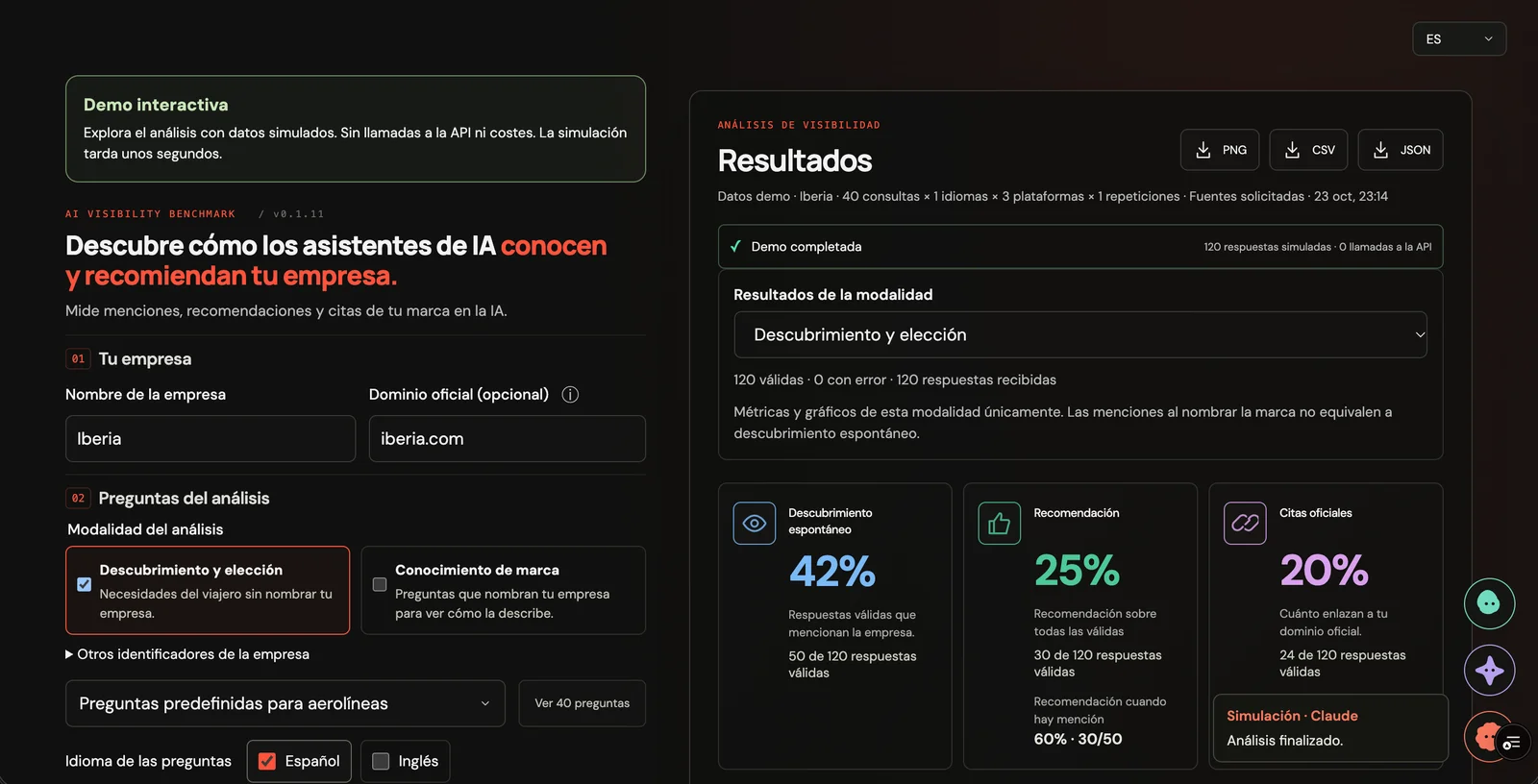
AI Visibility Benchmark organises the process. You can query models from OpenAI, Gemini, and Claude, select questions in Spanish and English, and run several repetitions. This lets you observe differences between providers and identify patterns within the sample.
The tool distinguishes two situations:
- Discovery and choice: questions that do not name the company, to observe whether it appears spontaneously among the options.
- Brand knowledge: questions that explicitly name the company, to examine what the model says about it.
This separates appearing when someone searches for options from receiving an answer when they already ask about your brand.
What the tool measures
The analysis shows whether a company is mentioned, receives a recommendation, and gets links to its official domain. When a numbered list of brands is recognised, it can also record their positions.
Each result retains the original response so you can review its context. A mention alone tells you little: you need to see what the model said and how it presented the company.
Execution errors are shown separately and excluded from rate calculations.
Your brand alongside competitors
You can add three to five competitors and compare their presence in the same responses.
This helps answer specific questions: which brands appear most often? Which receive recommendations? In which queries do competitors appear without the company being analysed?
Filter results by assistant, topic, and language. The comparison describes brand presence within that sample; its percentages do not represent market share.
Review links and identify gaps
AI Visibility Benchmark collects detected links and distinguishes official domains from external sources, making it easier to review which URLs appear alongside the responses.
A link has limited meaning: its presence does not demonstrate that the model consulted that page or that the page supports its claims.
The “What to improve” section groups questions where the brand did not appear. Each case includes counts, affected assistants, and response excerpts, with access to the full text. It is a starting point for investigating specific gaps without automatically assigning them a cause.
Questions tailored to each business
The initial set includes questions about airlines and travel situations with different budgets, destinations, and preferences.
You can also import your own questions through a CSV file and review their wording before running the analysis. This lets you build an evaluation around the queries that matter to each company.
Export results as CSV and JSON to analyse or keep them. Responses remain in memory during the session, so you need to export before leaving if you want to save your work.
How to interpret the results
The tool queries models through their APIs with web search disabled. Results may therefore differ from what someone receives in the ChatGPT, Gemini, or Claude applications with other features enabled.
Responses can also vary between runs, and automated classification has a margin of error. Indicators provide direction; the original response lets you check each case.
AI Visibility Benchmark offers a way to observe how a brand appears in AI responses and compare it with competitors under defined conditions. For people working on brand, content, or generative engine optimisation — GEO — it provides a concrete starting point for investigation.